


Tests to limit fruit cracking
Test conducted in Vignola (MO)
Variety: Sweet Aryana
Trials on cherry trees
At harvest
The trial on cherries took place from mid-April to early June and involved three foliar applications of 5 liters of Nano.T CaPO, alongside three applications of 7 liters of a commercial product, all carried out during the fruit-enlargement phase.
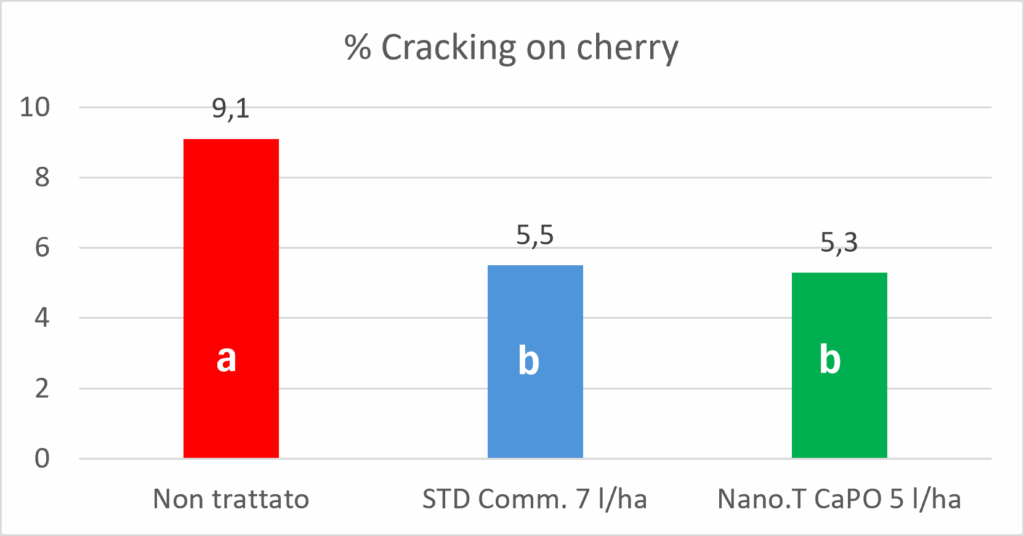
The amounts of calcium supplied differed significantly: a total of 4.7 kg/ha was applied using the commercial product, compared to only 0.8 kg/ha with Nano.T CaPO—approximately one-sixth of the amount used in the standard strategy (Graph 1; p<0.05). This has a major impact on NUE (Nutrient Use Efficiency), which represents the quantity of a nutrient absorbed by the plant relative to the amount actually applied.
As shown in Graph 1, the percentage of fruit cracking is similar for both treatment groups and significantly lower than that of the untreated control.
Consequently, the use of nano-calcium offers a clear advantage in terms of NUE.
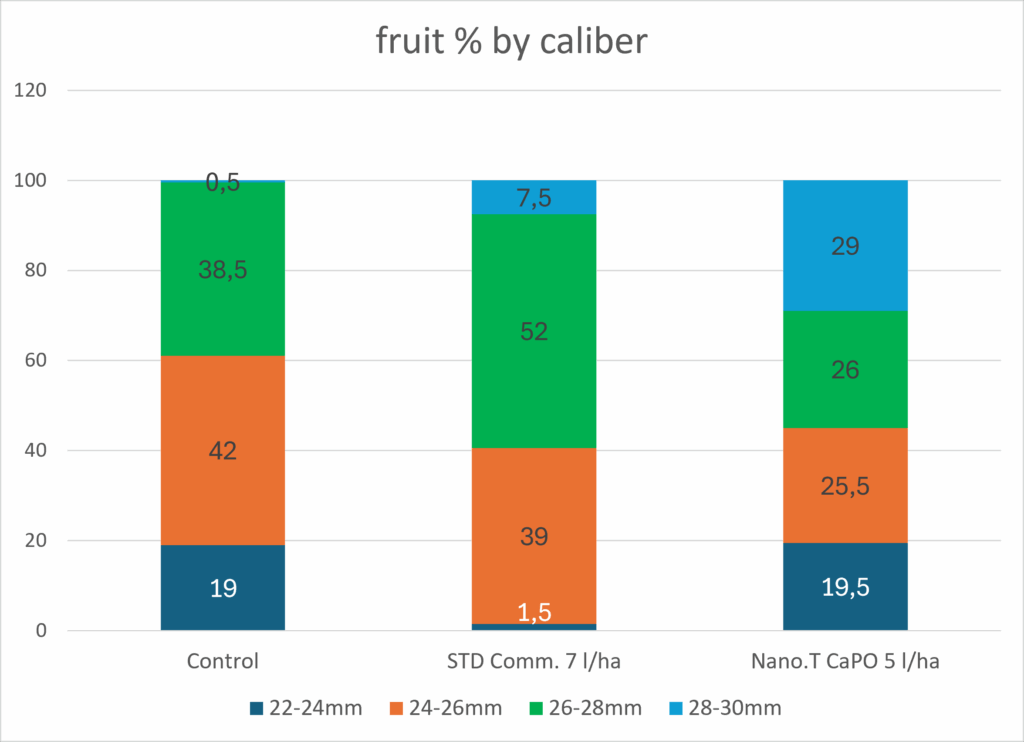
Assessments carried out on cherries have shown that treatment with nano-calcium (Nano-T CaPO) yields excellent results, including in terms of crop yield. Although the total number of fruits per plant remains essentially unchanged, treated plants produce cherries with larger diameters (Graph 2).
Given that larger-sized fruit commands a higher price on the market, this increase in size—and, consequently, in weight—translates into a significant economic benefit.
Trial conducted in Catania
Variety: Mogador
Trials on apricot trees
At harvest
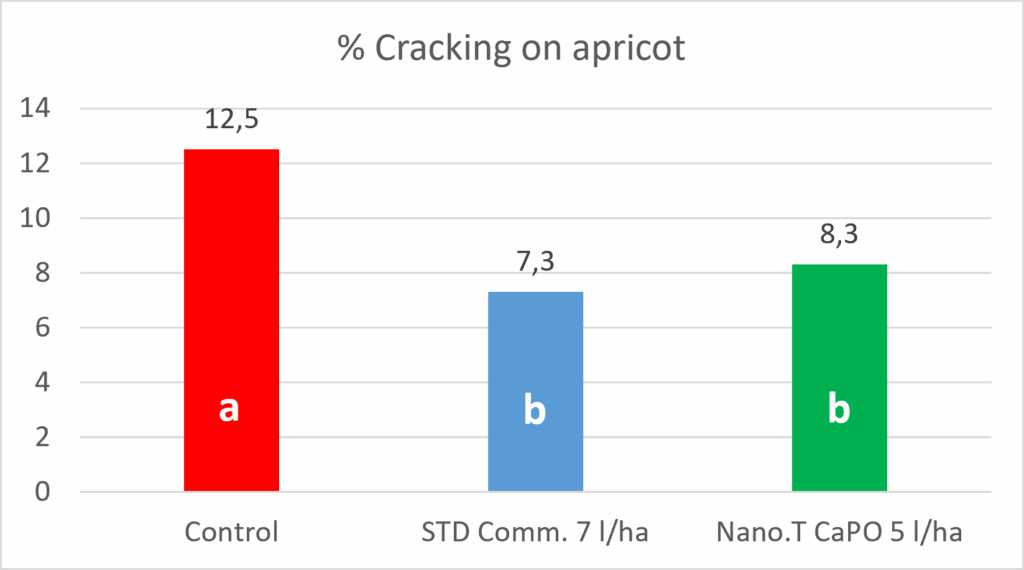
The trial on apricots took place from late March to mid-June and involved three foliar applications, similar to the procedure used for cherries. Consequently, the positive observations regarding the superior efficacy of Nano.T CaPo remain valid (Graph 3, p<0.05).
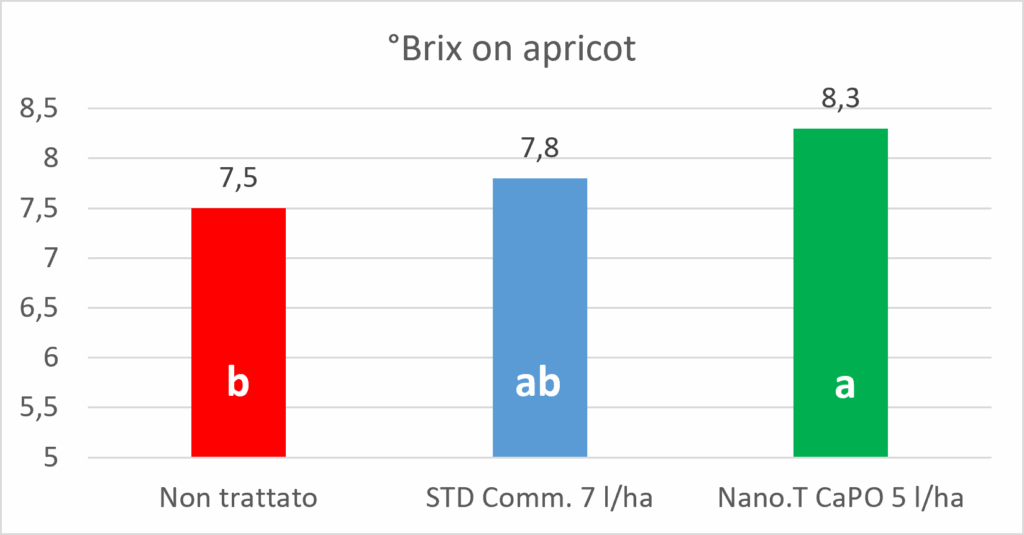
Regarding fruit sweetness (Graph 3), apricots treated with Nano.T CaPo showed a significantly higher Brix value compared to the untreated control (8.3 vs. 7.5), whereas the commercial standard (STD) did not show a statistically significant difference (7.8) (Graph 3, p<0.05).
Conclusions
Nano-calcium (Nano.T CaPO, patented by Cerea FCP) offers all the benefits of traditional calcium but with significantly greater efficacy, thanks to its particle size, which allows for easy absorption through the cell walls of the fruit (regarding calcium content in the fruit and peel, see: Mingtao Zhu et al. (2023) “Nano calcium alleviates the cracking of nectarine fruit and improves fruit quality,” *Plant Physiology and Biochemistry* 196 (2023) 370–380).
The tests revealed the following:
- Equivalent protection against cracking: a reduction in the incidence of split fruit.
- Sweeter fruit and good shelf life: an increase in Brix levels (enhancing flavor and sweetness) while maintaining fruit firmness post-harvest.
- Greater nutrient-use efficiency: achieving the same results requires only 1/6 of the calcium dosage compared to traditional products.