


Tests on arid ground
Trial conducted at Kafr Khazaal village (Egypt) by the Biotek Testing Center
Variety: Thompson Seedless
Comparison between nanoparticles and calcium chelate
at harvest
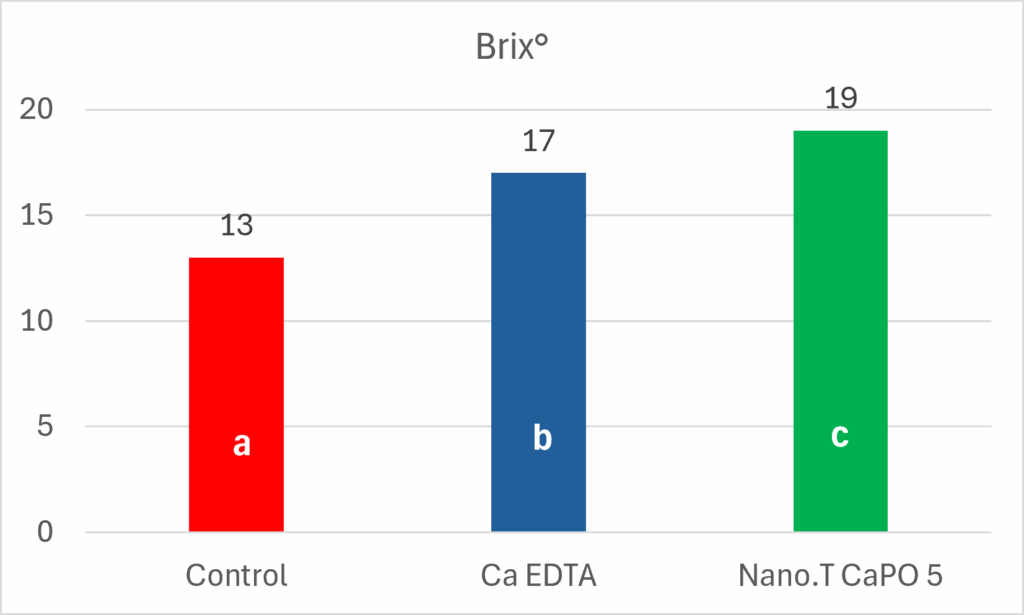
The performance of Nano.T CaPO showed statistically significant differences in terms of Brix degree—not only compared to the untreated control but also to a commercial chelated calcium product—despite the use of slightly lower calcium doses (0.5 and 0.7 kg/ha, respectively, applied in two separate treatments) during the summer (Graph 1; letters indicate an LSD value at p < 0.05).
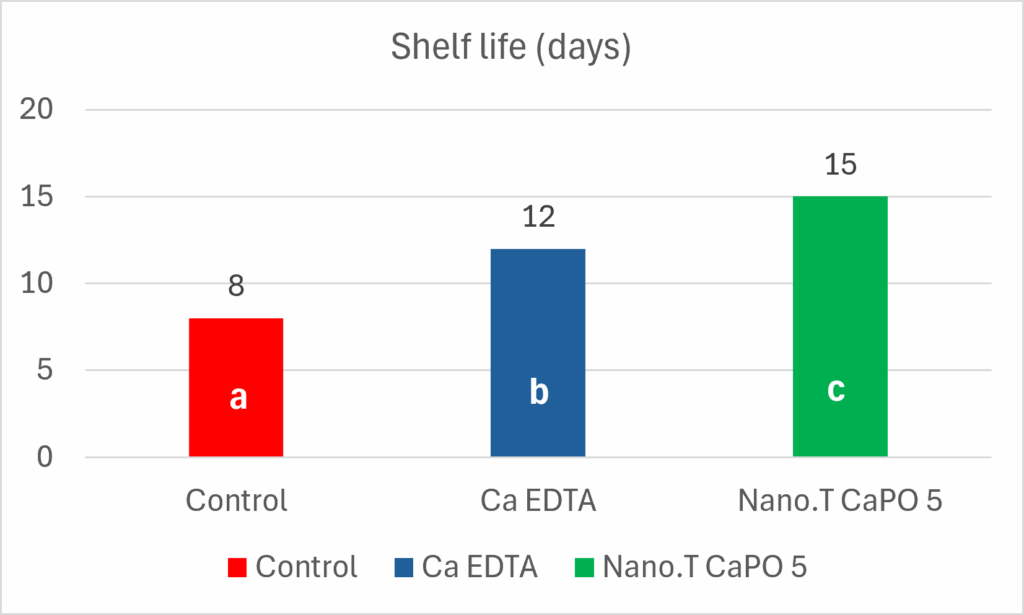
In Graph 2, it can be seen that products treated with nanoparticles remained suitable for commercialization for twice as long as untreated products—and, in any case, for significantly more days than the chelated product (the letters indicate an LSD at p < 0.05).
Conclusions
Nano.t CaPO offers all the benefits of traditional calcium, but with significantly greater efficacy, thanks to particle sizes that are easily absorbed by plant cell walls (regarding calcium content in the peduncle and fruit; see: Mingtao Zhu et al. (2024). “Preharvest nano calcium reduces the table grape berry abscission by regulating ethylene production during storage.” Journal of Plant Growth Regulation 43:1400–1409).
When used in arid soils for crops exposed to extreme temperatures, the product achieves superior results in terms of sugar content and shelf life compared to chelated products, while utilizing similar quantities of the active ingredient.